
Intermittent Reinforcement in Relationships
Why hot-and-cold love can be so hard to walk away from

Intermittent reinforcement in relationships happens when affection, attention, or reassurance is given inconsistently and unpredictably. The uncertainty of when the next positive moment will come can make those moments feel especially rewarding and make it surprisingly difficult to walk away.
It just doesn't make sense.
Maybe they've ignored your messages for days, insulted you several times this week, or repeatedly let you down when you needed them most. You've spent more time feeling anxious, confused, rejected, or hurt than you have actually feeling happy.
And you know it.
But then, just as you're about to throw in the towel, something changes. You receive a sweet one-line text or a tiny compliment. Or you see a flash of the person you've been desperately hoping still existed and would someday come back.
The relief feels like oxygen.
Suddenly, a breadcrumb feels like a three-course meal. The hurt gets pushed to the background, and your hope comes rushing back.
You think:
What if things are changing?
Maybe they do care.
This time could be different.
So, why do we stay when the bad so clearly outweighs the good?
The answer may lie in something called intermittent reinforcement - and once you understand how it works, your attachment to an inconsistent person will make a lot more sense.
What is Intermittent Reinforcement in Relationships?
If you’ve ever experienced intermittent reinforcement in relationships, you could be forgiven for thinking your brain has been hijacked and someone is holding your common sense to ransom
After all, if you know a situation isn’t good for you, why does your brain seem to ignore the memo? Why can someone treat you badly for days, yet one affectionate message has you floating around as if you’ve just won the lottery?
Well, there are a few factors at play.
Our brains are wired to learn from rewards.
Dopamine plays an important role in motivation and reward learning, but it doesn't simply give us a little burst of pleasure every time something nice happens. One of its more interesting roles involves something called a reward prediction error - essentially, the difference between the reward your brain expected and the reward it actually received.
When something turns out better than expected, dopamine neurons can increase their activity. When a fully expected reward arrives, that response is much smaller or absent. And when an expected reward doesn't appear, dopamine activity can decrease.
In other words, surprise matters.
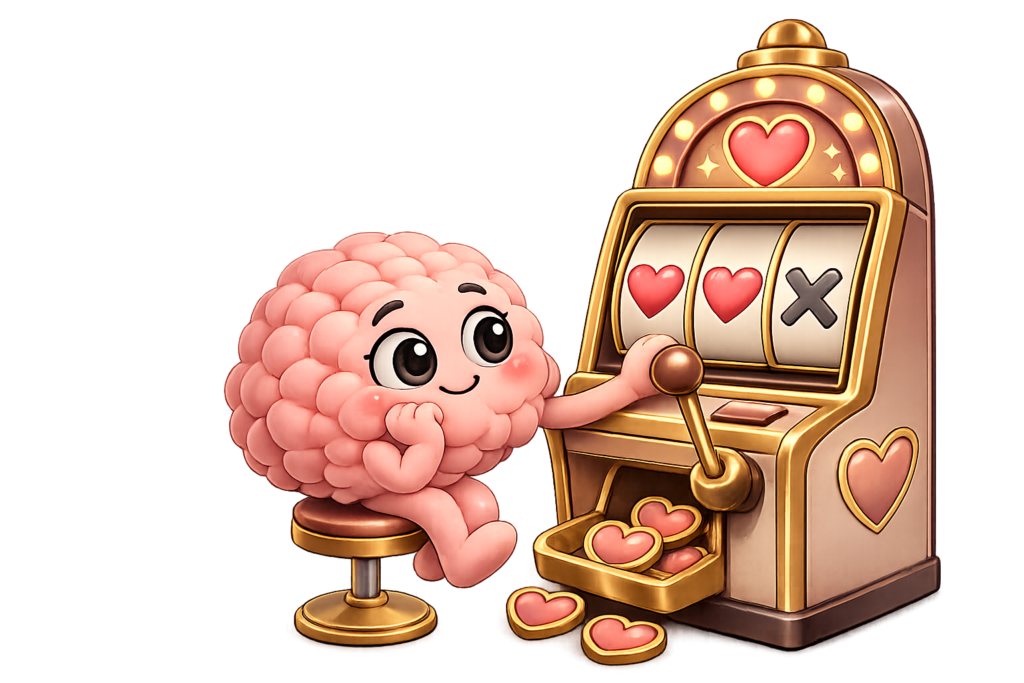
Imagine receiving a loving good-morning text from your partner every single day. It's lovely, but eventually it's also predictable. Your brain has learned to expect it.
Now imagine you've been staring at two blue ticks for three days after your partner suddenly withdrew. You've wondered what you did wrong, whether they're coming back, and whether they even care.
Then your phone lights up with:
“I miss you
.”
That reward is no longer predictable.
It's a surprise.
Reward-learning research shows that outcomes that are better than expected can generate positive dopamine prediction-error signals that help the brain learn from the experience.
This doesn't mean that an inconsistent partner is literally “giving you dopamine hits,” or that dopamine alone explains why you can't leave them. Human attachment is far more complicated than that. But it does help explain why unpredictable positive experiences can become so psychologically significant.
The Inconsistency Effect
This is where things get really interesting.
Imagine every time you reach for your partner, they respond affectionately:
Text → affection.
Text → affection.
Text → affection.
Then one day, the affection disappears.
You text. No response.
You try again. Still nothing.
Eventually, your brain has some pretty convincing new information:
This behaviour isn't producing the desired outcome anymore.
Now, imagine this pattern:
Text → ignored.
Text → ignored.
Text → huge affectionate response.
Text → ignored.
Text → loving reassurance.
Text → ignored.
Now, you've learned that being ignored doesn't necessarily mean the reward has disappeared permanently. Your previous experience has taught you something very different:
Sometimes I just have to keep trying.
The Relief Effect
And then there's another piece of the puzzle: relief.
If your partner is consistently affectionate and responsive, your nervous system gradually learns:
Affection is available. I don't have to search for it.
On the other hand, if your partner flips between being:
warm → distant → affectionate → disappearing → loving → detached → reassuring.
Suddenly, an enormous amount of mental energy becomes directed towards one question:
When will the good version come back?
In this scenario, it's common for the attachment system to become activated, leading you to seek closeness, reassurance, and signs that the relationship is safe. Research on attachment suggests that seeking proximity to an available and responsive attachment figure can help regulate distress and restore a sense of safety.
But there's an obvious problem when the person you're seeking comfort from is also the person creating the uncertainty. They become the knife and the Band-Aid: the source of the pain and the relief.
So when warmth finally returns, you're not necessarily experiencing affection in isolation. You're experiencing:
- The end of the waiting.
- The end of wondering.
- The end of rejection.
- The end of “Do they still care about me?”
And that relief can feel enormous.
Suddenly, a bare-minimum response can feel like the grandest romantic gesture of your life.
This may also help explain one of the cruellest parts of these relationships: knowing someone is bad for you doesn't necessarily make your attachment to them disappear.
Signs of Intermittent Reinforcement in Relationships
Some of the clearest signs are less about how often someone is loving and more about the unpredictable contrast between reward and withdrawal.
Hot-and-cold affection
They can be incredibly warm, loving, attentive, or intimate and then suddenly become distant or unavailable.
Unpredictable communication:
Sometimes they reply immediately or talk to you for hours; other times they disappear, ignore messages, or offer very short replies.
Affection after withdrawal:
Just when you’re reaching your limit or beginning to pull away, warmth suddenly returns.
Promises followed by disappointment:
They give you hope that things will change, improve, or become more committed, but the change rarely lasts.
Rare moments of intense connection:
The relationship may contain occasional wonderful days, conversations, trips, sex, or displays of affection surrounded by much longer periods of uncertainty.
Breadcrumbing:
Small amounts of attention - a compliment, an affectionate message, or an “I miss you” comment can be enough to reignite hope and reel you back in.
Relief becomes confused with happiness:
Their return after a period of distance feels euphoric, partly because it ends the anxiety their withdrawal created.
You become focused on the next “reward”:
You find yourself checking your phone, analysing their mood, watching for any signs of affection, or wondering when the loving version of them will return.
The good moments feel disproportionately important:
One affectionate evening can seem to erase or temporarily outweigh days or weeks of hurt.
You modify your behaviour to "win them back":
You may become more accommodating, avoid raising concerns, give more, ask for less, or try to recreate whatever seemed to produce closeness before.
You stay because of potential rather than "what is":
Your attachment becomes centred on who they sometimes are and the hope that this version will eventually become permanent.
Leaving feels strangely difficult even if you’re unhappy:
Logically, you can see that the relationship gives you far more anxiety than security, yet emotionally, you feel intensely attached.
Why Is Intermittent Reinforcement So Hard to Get Over After a Breakup?
You know the relationship wasn't good for you, maybe even toxic. You remember the ignored messages, the hurt, the anxiety, and all those awful nights you spent wondering where you stood. So why, now that it's over, does your brain suddenly seem determined to create a Greatest Hits highlight reel of the five times they were wonderful?
Why are you checking your phone, replaying conversations, and secretly hoping they'll reach out - even when another part of you knows you don't actually want the relationship back?
Unfortunately, ending the relationship doesn't instantly undo everything your brain learned while you were in it.
Your brain learned to keep trying
Remember the pattern we talked about earlier?
Ignored → ignored → affection → ignored → affection.
Over time, periods without affection stopped reliably meaning that the affection wasn't coming.
Sometimes they just meant: Not yet.
As mentioned before, this relates to the Partial Reinforcement Extinction Effect (PREE). When a behaviour has previously been rewarded only some of the time, that behaviour can persist for longer after the reward disappears than behaviour that was consistently rewarded.
In other words, if nothing has always been part of the pattern, another nothing doesn't necessarily tell your brain to stop trying.
And that's particularly cruel after a breakup. A week without hearing from them might logically mean the relationship is over. But during the relationship, perhaps a week of distance was followed by an affectionate message. Maybe they disappeared and came back before. Maybe every time you finally started giving up, they suddenly pulled you close again.
Your brain has a whole catalogue of evidence saying:
"They come back."
So part of breaking free from intermittent reinforcement involves learning something completely new:
This time, the reward isn't coming.
Your Attachment Doesn't Disappear When the Relationship Does
There's another complication.
You can decide that someone isn't good for you long before your attachment system gets the message. As humans, we naturally seek proximity to attachment figures when we're distressed. When that person is available and responsive, their presence can provide feelings of safety and relief.
But intermittent reinforcement can create a particularly painful contradiction when the person you seek for comfort is also the person whose behaviour has repeatedly caused your distress.
When they withdraw, you hurt.
When they return, the pain temporarily stops.
So after the breakup, you may find yourself craving the very person you know you need to stay away from. That's not necessarily because you've changed your mind about the relationship. You might just be craving something much more immediate:
Relief.
Research involving women who had recently left abusive relationships found that intermittent maltreatment and power imbalances were associated with stronger attachment to former partners, including at follow-up months after separation. This doesn't mean every inconsistent relationship is abusive, nor does intermittent reinforcement automatically mean you've developed a trauma bond. But it does demonstrate something important:
Leaving someone and becoming emotionally detached from them aren't necessarily the same thing.
Your Brain Might Start Chasing the Highs
There's also a pretty 'unfair trick' your memory can play after the relationship ends. When you're hurting, your mind may keep returning to the relationship's most emotionally intense moments
So instead of remembering the relationship as one continuous average, your mind may jump between its most emotionally charged moments:
- That incredible weekend.
- The night they told you how much you meant to them.
- That message you couldn't stop rereading.
- How they held you.
- Who they were at the beginning.
You aren't missing the anxiety, confusion, and disappointment. You're missing the reward buried amongst it.
And because those rewarding moments were scarce and unpredictable, you may have spent much of the relationship anticipating them, searching for them, and assigning enormous significance to them.
The relationship may be over, but that anticipation doesn't disappear overnight.
Silence Can Feel Worse Before It Feels Better
This is also why no contact can initially feel so uncomfortable. You're removing the entire cycle:
uncertainty → anticipation → reward → relief → withdrawal → uncertainty.
There is no surprise text. No sudden reassurance. No tiny breadcrumb to turn into a three-course meal.
And initially, that can feel less like freedom and more like deprivation.
You may even experience an urge to do something - check their social media, reread old messages, look at their online status, manufacture a reason to contact them - all because your brain has learned that persistence has sometimes been rewarded. But every time you refuse to restart the cycle, you're giving your brain new information.
Silence stops meaning:
Maybe the reward is coming.
Eventually, it can simply mean:
There's nothing I need to wait for.
And that's when the exhausting game of “When will the good version come back?” can finally begin to lose its grip.
How to Break the Cycle of Intermittent Reinforcement in Relationships

Go no contact:
If intermittent reinforcement has left you constantly waiting for the next scrap of affection, it can help to borrow a page from the addiction recovery playbook and go cold turkey.
Intermittent reinforcement isn't literally an addiction, but the analogy is useful: every unexpected text, affectionate reunion, late-night check-in, or sudden “I miss you” has the potential to give the cycle another spin. No contact takes the unpredictable reward off the table.
And no - no contact isn't about making them miss you, teaching them a lesson, or waiting '30 days' for them to realise what they've lost. If you're secretly counting the days until they come back, you're still playing the slot machine.
No contact is about getting yourself out of the casino altogether.
In reality, complete no contact isn't always practical or possible. You may need to co-parent, work together, share friendship groups, or live nearby. In that case, the next best thing is low contact: keep communication brief, practical, and predictable, and avoid unnecessary emotional conversations that could pull you back into the cycle.
Remove the "Maybe"
"Maybe they'll text."
"Maybe they just need some space."
"Maybe they'll realise how much they love me."
"Maybe this time they'll actually change."
Intermittent reinforcement thrives on maybe. When affection has disappeared and returned before, it's incredibly easy to interpret another disappearance as not yet rather than it's over.
You don't need to know whether they'll ever come back. You only need to stop organising your life around the possibility that they might.
Try replacing
“Maybe they'll come back” with “I'm not waiting to find out.”
Stop Giving Yourself Tiny 'Hits' of the Person
No contact loses some of its power if you haven't sent a message for three weeks, but you're checking their Instagram twelve times a day.
Notice the little ways you keep yourself connected:
- Rereading old conversations
- Looking through photographs
- Checking when they're online
- Watching their stories
- Asking friends about them
- Searching for clues about what they're doing
These behaviours aren't the same as receiving intermittent reinforcement directly from the other person, but they can keep your attention firmly attached to them. You don't have to delete every photograph and ceremonially launch your phone into the sea. Just make access less immediate. Mute. Unfollow. Archive the chat. Move photographs somewhere you won't stumble across them.
Give your mind fewer opportunities to go looking for crumbs.
Expect the Urge to Get Worse Before It Gets Better
Unfortunately, removing the reward doesn't necessarily produce instant peace.
Initially, you may even think about them more. You might suddenly feel desperate to check their profile or convince yourself that sending one small message couldn't hurt.
But don't let increased discomfort convince you that no contact isn't working. When a behaviour stops producing a reward that previously reinforced it, that behaviour can sometimes temporarily intensify before it begins to decrease - a phenomenon known as an 'extinction burst'.
So when the urge arrives, remember: An urge isn't an instruction.
You can want to check up on them, be desperate to text, and crave reassurance - but still choose not to act on it.
Separate the Person From the Relief
Sometimes “I need them” actually means:
"I need this feeling to stop."
Remember the knife-and-Band-Aid metaphor? When the same person repeatedly triggers your distress and then provides the affection that relieves it, their return can start to feel uniquely soothing.
So when you're craving contact, get curious about what you're really craving.
Is it reassurance? Connection? Validation? Comfort? Distraction? Certainty? Relief from anxiety?
Once you've identified the need, ask yourself:
"How else can I meet it?"
Call someone safe. Leave the house. Write down what you're feeling. Put your phone somewhere else and do something absorbing. Move your body. Cry if you need to. The goal isn't to convince yourself that you don't miss them. It's to teach yourself that they aren't your only route to feeling better.
Keep a Reality List
When you miss someone, your brain can become an extremely selective historian.
Suddenly you're remembering that incredible weekend away and conveniently forgetting the three weeks afterwards when you barely knew where you stood.
Write yourself a reality list while your head is clear.
- What behaviors repeatedly hurt you?
- How did you feel most of the time?
- Which needs went unmet?
- How many times did you think things had finally changed, only for the same pattern to return?
The purpose isn't to demonize the other person or convince yourself that every moment was terrible. It's about remembering the whole relationship, rather than letting a handful of beautiful moments speak for it all.
Replace Unpredictability With Predictability
After spending months or years riding emotional rollercoasters, stability can initially feel strangely... boring.
That's okay.
Start deliberately adding predictability back into your life: regular meals, sleep routines, exercise, hobbies, planned social contact, work routines, walks, weekly rituals, and time with people whose affection doesn't disappear without warning.
You're replacing:
Will they?
Won't they?
Maybe.
Maybe not.
with:
"I know what happens next."
It's surprising how wonderful consistency, predictability, and routines can feel after the whirlwind of intermittent reinforcement in relationships.
If you've spent months wondering why you couldn't walk away from someone who gave you so little, it's time to give yourself a little grace.
Intermittent reinforcement in relationships can teach you to wait, hope, chase, and assign enormous value to the smallest scraps of affection. But what has been learned can also be unlearned.
Every time you stop chasing the next reward, choose reality over maybe, and find comfort somewhere that doesn't require you to hurt first, you're stepping out of the cycle. Eventually, that breadcrumb stops looking like a three-course meal, and you remember that you were always allowed to want the whole damn thing.
Other articles you may find interesting:



Signs An Avoidant Is Done With You
How to tell the difference between deactivations, shutdowns, and discards.