
Trauma Bond Relationship: Signs, Psychology, and How to Break Free
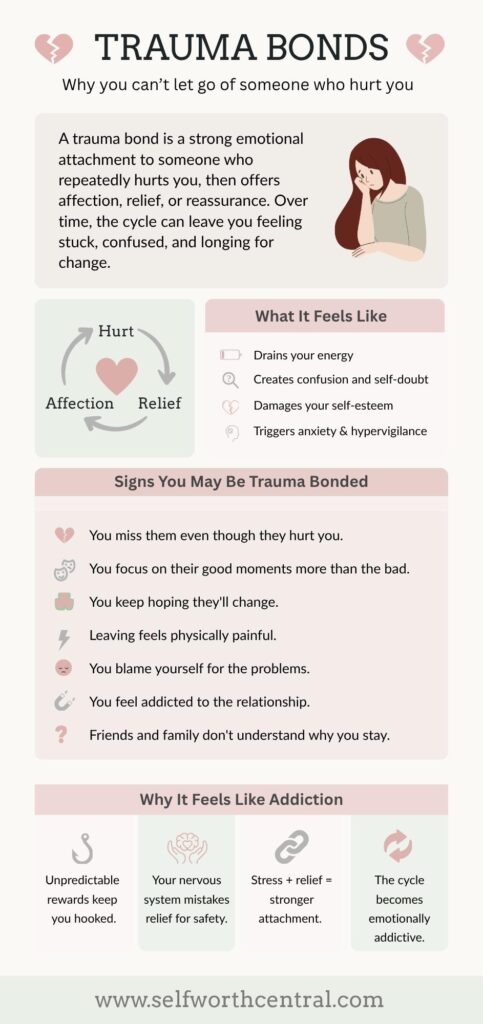
Why you can't let go of someone who hurt you

A trauma bond relationship is an unhealthy relationship in which periods of pain, rejection, or mistreatment are repeatedly followed by moments of affection, reassurance, or relief. Over time, this cycle can create a powerful emotional attachment that leaves you feeling stuck, confused, and unable to let go - even when the relationship is hurting you.
Logically, you know the relationship isn’t healthy. Your friends have told you. Your family has told you. Heck, you’ve even told yourself!
And yet, you still can’t let go.
You find yourself asking:
"Why do I miss someone who made me cry?"
"Why do I crave someone who made me question my worth?"
"Why am I still attached to someone who hurt me?"
If you’ve ever asked yourself these questions, you’re not alone. And more importantly, you’re not crazy.
You may be experiencing what psychologists refer to as a trauma bond.
While the people around you may wonder why you can't simply walk away, trauma bonds aren't driven by logic.
They're driven by hope.
- Hope that they'll change.
- Hope that things will go back to how they were in the beginning.
- Hope that the next conversation, apology, or moment of affection will finally make everything okay.
In this article, we'll explore what a trauma bond relationship is, how they develop, the signs to look for, and most importantly - how to break free and start reclaiming your peace.
Signs You May Be in a Trauma Bond Relationship

One of the most frustrating things about a trauma bond relationship is that you often don’t realize you’re in one until you’re already emotionally tangled up in it.
At first, it feels like love. Maybe even the best connection you’ve ever had.
Then something changes.
The person who once made you feel special becomes distant. The person who couldn’t wait to hear from you suddenly takes hours (or even days) to reply.
The person who once felt safe becomes the very person triggering your anxiety. And yet, instead of pulling away, you find yourself becoming even more attached.
If you’re wondering whether this might be happening to you, here are some common signs.
1. You Keep Waiting for the Old Version of Them to Come Back
The version of them that was attentive, affectionate, and consistent. The one who made you believe this relationship could be something special.
Instead of evaluating who they actually are today, you find yourself holding onto the memory of who they used to be.
You keep thinking:
"Maybe they'll come back."
"They must still be in there somewhere"
"Maybe things will go back to how they were."
2. You Become Their Defense Attorney
Your friends are concerned. Your family is concerned. Even your dog is probably concerned at this point.
But somehow, you always find yourself explaining their behavior away.
"They're just stressed."
"They've been through a lot."
"They're scared of intimacy."
"They didn't mean it."
Empathy is a beautiful quality. Unfortunately, it can also become an act of self-abandonment when you’re constantly using it to excuse behavior that hurts you.
3. The Good Moments Feel Bigger Than the Bad Ones
A single loving text can make your entire week. One good conversation can erase months of confusion. One affectionate weekend can convince you that all the painful parts of the relationship were just a 'misunderstanding'.
The highs become so emotionally powerful that they overshadow everything else.
4. Your Mood Depends on Them
When they text, you feel relief. When they disappear, you feel anxious. When they’re warm, you’re okay. When they’re distant, you’re spiraling.
Your emotional state starts revolving around someone else’s behavior.
At some point, the relationship stops feeling like something you want and starts feeling like something you need to feel okay.
5. You Leave... Then Get Pulled Back In
You tell yourself you’re done. You create distance, block them, and swear you’ll never put yourself through this again.
Then they reach out. Or you start missing them. Or your brain starts playing the highlight reel and conveniently leaves out the part where you were crying in the bathroom, questioning your worth, and wondering why someone who claimed to care about you could also make you feel so small.
And suddenly, you’re right back where you started.
6. You've Earned an Honorary Degree in Their Psychology
You know their attachment style. You know their childhood wounds. You know their trauma history. You know why they pull away, why they struggle with intimacy, and what happened in their last relationship.
At this point, you could probably write a dissertation on them!
The problem is that you’ve become so focused on understanding them that you’ve stopped asking a much more important question:
"How is this relationship affecting me?"
7. Part of You Knows Better... But You Still Can't Let Go
This is often the hardest sign to admit because part of you already knows the truth.
You know the relationship isn’t giving you what you need. You know it’s affecting your mental health. And you know you’re not getting the consistency, security, or emotional safety you deserve.
Yet another part of you still longs for them. Still misses them. Still hopes.
That internal tug-of-war can leave you feeling confused, frustrated, and ashamed. But here’s the truth: trauma bonds don’t happen because someone is weak.
They happen because hope is addictive, attachment is powerful, and pain can become dangerously tangled up with relief.
What Does a Trauma Bond Look Like?
One of the reasons trauma bond relationships can be so difficult to recognize is that they don’t usually start with pain and confusion.
They start with chemistry, connection, possibility, and hope.
Nobody wakes up one morning and thinks,
“You know what sounds fun? Getting attached to someone who’ll eventually turn me into a nervous wreck.”
That’s not how it works.
Instead, the relationship slowly becomes a cycle of hurt and relief, disappointment and hope, distance and reconnection. Over time, you become attached not just to the person, but to the possibility of finally getting the relationship you’ve been waiting for.
Here are some common examples:
The Hot-and-Cold Partner
One week, they’re obsessed with you. They’re texting first, making plans, complimenting you, and generally acting like you’re the best thing that’s happened to them in years.
The next week?
They’re distant, withdrawn, irritable, and suddenly impossible to reach.
Just as you’re about to give up, they return - warm, affectionate, attentive - and your nervous system breathes a huge sigh of relief. You tell yourself,
“See? I knew they cared.”
And then the cycle starts all over again.
It’s important to note that not every hot-and-cold relationship is a trauma bond. Sometimes, inconsistency stems from emotional immaturity, poor communication skills, attachment wounds, or personal struggles. The difference is that in a trauma bond, the cycle becomes so powerful that you struggle to leave despite the ongoing emotional cost.
The Boomerang Ex
You’ve broken up more than once. Maybe more than ten times.
Every time you finally begin moving forward, they come back declaring that they miss you, they’ve changed, they’ve realized what they lost, and this time will be different.
For a while, things improve, but soon the same issues reappear. The relationship becomes less about reality and more about hope - hope that this reunion will finally be the one that works out.
The Emotional Roller Coaster
Some days you feel loved. Some days you feel invisible. Some days, you’re planning a future together. Some days, you’re wondering whether they even care.
The highs feel incredible. The lows feel devastating. And somewhere along the way, the chaos starts feeling like a normal part of the ride.
Emotional whiplash, much?!
The Controlling Partner
At first, it seems like interest or concern. They want to know where you are, who you’re with, what you’re doing, and why you’re taking so long to reply. They frame it as protection, caring, or love.
But gradually, your world becomes smaller. You stop trusting your own instincts and start second-guessing yourself. Over time, you become more dependent on the very person making you feel insecure.
The Relationship Built on 'Potential'
This one catches a lot of people.
You’re not staying because of who they are. You’re staying because of who they could be.
You see glimpses of kindness. Moments of vulnerability. Brief flashes of the person you know they’re capable of being. You become emotionally invested in their potential while ignoring the reality of how the relationship consistently makes you feel.
Why Trauma Bonds Are So Confusing
One of the reasons trauma bonds are so confusing is that they rarely feel bad all the time. If they did, most people would leave much sooner.
Instead, the relationship often contains just enough positive moments to keep hope alive. That’s what makes trauma bonds so difficult to break. The good moments become increasingly difficult to separate from the pain surrounding them, and you end up attached not just to the person, but to the relief they provide after hurting you.
Trauma bond withdrawal symptoms

A common misconception people make after leaving a trauma bond is assuming that they'll feel better right away.
After all - if a relationship hurts you, why would you feel even worse when it's over?
People often wonder:
"Why am I crying over someone who treated me badly?"
"Why am I fighting the urge to text someone I know isn't good for me?"
And
"Why do I feel like I'm going through a breakup and detox at the same time?"
The answer is simple:
Because in many ways, you are.
It Can Feel Like Withdrawal
When you’ve spent months or years cycling through hope, disappointment, relief, and emotional highs and lows, your brain and nervous system become accustomed to that pattern. You get used to waiting for the next text. The next apology. The next breadcrumb. The next moment that makes everything feel okay again.
Then suddenly, it’s gone.
And your nervous system starts screaming:
"Where is it?"
"What happened?"
"How do I get it back?"
This is why so many people experience symptoms that feel surprisingly similar to withdrawal.
Common Trauma Bond Relationship Withdrawal Symptoms
You may find yourself:
- Constantly thinking about them
- Replaying old conversations
- Obsessively checking your phone
- Stalking social media
- Fantasizing about reconciliation
- Struggling to focus on everyday tasks
- Feeling anxious or panicked
- Experiencing intense sadness or grief
- Feeling restless, agitated, or emotionally overwhelmed
- Questioning your decision to leave
- Missing them despite everything that happened
Many people are shocked by how intense these symptoms can feel.
They think:
"If the relationship was so unhealthy, why do I miss them this much?"
The Good Memories Start Taking Over
One of the strangest parts of withdrawal from a trauma bond relationship is that your brain suddenly becomes an expert at remembering the good times. You remember the romantic weekend, sweet texts, inside jokes, and the moments when they made you feel genuinely loved.
Meanwhile, the painful memories start fading into the background. It’s almost as if your brain has hired a PR team whose sole purpose is convincing you that returning to the relationship is a fantastic idea.
Unfortunately, that PR team tends to leave out a few important details — like the anxiety, the confusion, the tears, the disappointment, and the countless nights you spent wondering where you stood.
But this doesn’t mean you belong together. It doesn’t mean the relationship was meant to be. And it certainly doesn’t mean you should go back.
Missing someone is not proof that they’re good for you. Craving someone’s attention is not proof that they’re your soulmate. Struggling to let go is not proof that you should return. More often than not, it’s proof that your nervous system became attached to a cycle.
The good news is that withdrawal symptoms are temporary. They may be uncomfortable (sometimes incredibly uncomfortable), but they do ease.
Every time you resist the urge to check their social media, choose not to send the text, or redirect your attention back to yourself, you weaken the bond. Little by little, your nervous system begins to settle. Things get easier. And eventually, what once felt impossible to live without becomes something you rarely think about at all.
How to Break a Trauma Bond
Anyone who’s tried to heal from a trauma bond relationship will tell you it’s no easy feat. You might be able to leave physically, but it’s often much harder to detach mentally and emotionally.
After all, just because someone knows a drug is bad for them doesn’t mean it’s easy to give it up.
Nothing about a trauma bond is logical. If it were, nobody would cry over someone who gave them anxiety, confusion, insomnia, and a nervous system that now reacts to a WhatsApp notification like it’s a medical emergency.
It’s common to get frustrated after the relationship ends. You may think,
“I should be over it by now.”
You try to stay busy, think positively, and fake it till you make it.
But months later, you’re still thinking about the relationship more than you’d like to admit. Still replaying conversations. Still checking social media and still wondering whether the other person misses you. Still feeling that horrible pull to go back, even though you know exactly how badly it ended last time.
If that’s you, please hear me:
This doesn’t mean you’re weak, pathetic, or secretly addicted to suffering.
It means your mind and body got attached to a cycle that now needs time, space, and consistency to unlearn. Breaking a trauma bond is less about “snapping out of it” cold turkey style, and more about gradually teaching your nervous system that you are safe without the person who hurt you.
1. Recognize That What You're Feeling Is Withdrawal
One of the most important parts of healing is understanding that what you’re experiencing might not just be heartbreak. It might be withdrawal too.
When a relationship is built around cycles of hope, reward, disappointment, and relief, your brain gets used to constantly waiting for the next emotional “hit” — the next text, the next apology, the next breadcrumb, the next moment that makes you think,
“Okay... maybe things really will be different this time.”
Then the relationship ends, and your nervous system basically goes,
“Excuse me? Where did the source of chaos and occasional comfort go?”
That’s why trauma bond recovery can come with intense cravings, obsessive thinking, urges to reach out, panic, sadness, and a brain that seems determined to romanticize someone who made your life significantly worse.
Understanding this doesn’t make it comfortable, but it does make it less confusing.
2. Create Distance From the Source of the Bond
This is the part nobody likes, but healing is much harder when the cycle is still active.
Every text, breadcrumb, social media post, accidental run-in, and moment of false hope has the potential to reopen the wound and drag you straight back into the emotional whirlwind. That’s why no contact is often recommended after a trauma bond relationship. It’s much easier to heal a wound that isn’t repeatedly being poked.
Of course, no contact isn’t always possible. You may share children, work together, live nearby, or have unavoidable responsibilities. In those situations, low contact is usually the next best option. Keep communication brief, practical, and as emotionally neutral as possible.
3. Stop Looking to Them for Closure
This one is particularly hard because most people stuck in trauma bonds are still waiting for that elusive conversation.
The explanation. The apology. The sudden moment of accountability where the other person finally says,
“You’re right. I hurt you. I was inconsistent. I was selfish. I created confusion, and you didn’t deserve that.”
Would that be amazing? Of course.
Is it likely? Probably not.
Real closure rarely comes from the person who created the confusion in the first place. Frustratingly, it usually comes from accepting what their behavior has already shown you.
- Not what they promised.
- Not what they almost became.
- Not what they said in one emotionally intense conversation at 1 a.m.
What they consistently showed you.
4. Focus on the Relationship You Actually Had, Not the One You Kept Hoping For
Trauma bonds survive on a diet of potential, hope, and “what ifs.”
It’s not just that you miss the person. You miss who they were in the beginning, the good moments, and the future you hoped you might have together. That can make it incredibly difficult to see the relationship clearly.
At some point, it helps to ask yourself some uncomfortable questions:
What did I consistently receive from this relationship?
How often did I actually feel safe, valued, and secure?
Was I attached to who this person truly was, or to who I hoped they would become?
There is a big difference between grieving a real relationship and grieving the fantasy of what you hoped it would become.
5. Rebuild Trust in Yourself
Many people leave trauma-bonded relationships feeling embarrassed or angry with themselves. They wonder how they missed the warning signs, why they stayed so long, or why they kept going back.
But blaming yourself for being trauma bonded is a bit like yelling at someone for limping after they’ve sprained their ankle. You’re criticizing the injury instead of caring for it.
Instead of asking, “What’s wrong with me?” try asking:
What was I hoping for?
What need was I trying to get met?
What part of me felt so attached to this person?
Healing becomes easier when you approach yourself with curiosity instead of contempt.
6. Rebuild a Life That Doesn’t Revolve Around Them
Trauma bonds tend to become the emotional center of someone’s world. Even when the relationship is miserable, it can still become the main thing they think about, analyze, hope for, and recover from.
So part of healing is gently expanding your world again.
That might mean reconnecting with friends and family who make you feel safe, joining support groups, going to therapy, taking up hobbies that absorb your attention, moving your body, spending time in nature, or returning to creative projects and personal goals.
This isn’t about “keeping busy” so you don’t feel. It’s about reminding your mind and body that connection, meaning, and safety still exist outside the relationship.
7. Let Yourself Grieve
You can’t skip this part, as much as you may wish you could.
Ending a trauma bond relationship isn’t just about giving up a person. It’s about grieving the person you thought they were, the future you imagined, the effort you poured in, the hope you kept carrying, and the version of you who believed love would eventually win if you just hung on a little longer.
That’s a lot to lose, and it deserves compassion.
Breaking a trauma bond isn't about becoming cold or pretending you never cared. It’s about teaching yourself that chaos is not chemistry, confusion is not intimacy, and longing is not proof that someone is right for you.
You won't wake up one morning and be magically “over it.” But little by little, the fog lifts, cravings ease, the pedestal comes down, and the person who once felt impossible to live without becomes someone you can finally see clearly.
Other articles you may find interesting:



Signs An Avoidant Is Done With You
How to tell the difference between deactivations, shutdowns, and discards.