
Fearful Avoidant Attachment: The Complete Guide
Understanding the signs, triggers, push-pull cycle, and healing

Fearful Avoidant Attachment, also known as disorganized attachment, is one of the four main attachment styles. It is characterized by a strong desire for emotional closeness combined with a fear of intimacy, rejection, or being hurt. People with this attachment style may seek connection and reassurance, then pull away or become overwhelmed when a relationship feels too close. This can create an unpredictable push-pull pattern in relationships, where closeness feels comforting and threatening at the same time.
It Started Out Great… Or at Least, Promising
The chemistry was out of this world. They seemed interested, invested, and thrilled to spend time with you. They opened up, got close, and the connection felt like nothing you’d ever experienced before. It really felt like this could be the start of something special.
Then, suddenly, something shifted.
You went from someone they couldn’t get enough of to someone they seemed almost indifferent about. They became harder to read and needed more space. Their communication patterns changed, and they seemed unsure about feelings they had previously appeared so certain about.
Or maybe the connection always felt more like a game of roulette?
It was a constant merry-go-round of push and pull, hot and cold. One day, you were treated like the love of their life; the next, you were downgraded to an acquaintance. You never quite knew where you stood. And eventually, you started questioning your own sense of reality.
“Maybe I imagined the closeness.”
“Did I misread things?”
“Did I do something wrong? Did I come on too strong?”
“Why do they keep coming closer if they don’t actually want a relationship?”
“Did they lose feelings?”
So naturally, you gave them space…
Then they came closer again. You reconnected. Things felt warm again, and you thought:
"Okay. We’re back on track."
Until closeness became uncomfortable again… and the cycle started all over again.
If any of this sounds painfully familiar, you’re not imagining the inconsistency, and you’re certainly not alone in finding it confusing. You may have stumbled upon someone with a fearful-avoidant attachment style.
What Is a Fearful Avoidant Attachment Style?
Fearful Avoidant attachment is an insecure attachment style characterised by relatively high levels of both attachment anxiety and attachment avoidance.
- Attachment anxiety relates to concerns about rejection, abandonment, and whether other people will remain available and responsive.
- Attachment avoidance relates to discomfort with emotional dependence, vulnerability, intimacy, and relying on other people for support.
Unlike dismissive-avoidant attachment, where independence and emotional distance tend to dominate, fearful-avoidants (FAs) fluctuate between seeking connection and avoiding it. They can move towards a partner when they feel distant, only to pull away when the relationship starts to feel too close - creating the classic fearful-avoidant push-pull dynamic.
It’s essentially a constant internal tug-of-war between:
“I want you close … but closeness doesn’t feel safe.”
FAs can have a strong attachment system where relationships matter deeply to them but still simultaneously rely on strategies designed to suppress or escape those attachment needs. In attachment research, these coping strategies are often described as hyperactivation and deactivation.
Hyperactivating strategies increase attachment-related thoughts, emotions, and proximity-seeking. The person may become particularly alert to signs of rejection, separation, or changes in their partner's behaviour.
Deactivating strategies do almost the opposite. They reduce attachment-related distress by suppressing vulnerable feelings, increasing emotional distance, emphasising independence, or mentally disengaging from the relationship.
Fearful avoidance is interesting because both strategies can exist within the same person.
Both states can be completely genuine. And that’s what makes fearful-avoidant attachment so confusing - not only for the person experiencing it, but also for the people trying to love them.
What Makes Fearful Avoidant Attachment So Confusing?

Being romantically involved with a fearful avoidant made me understand how disoriented Alice must have felt when she landed in Wonderland.
The caterpillar talked in endless riddles. The Cheshire Cat pointed both ways at the same time. The White Rabbit was impossible to catch, and every time she got comfortable at the party, the rules changed.
To say I found the dynamic confusing would be the understatement of the century.
Fearful-avoidant attachment can feel mind-bending to those on the receiving end because the person often seems to want two completely opposite things at once. They can want:
Closeness - until it feels dangerous.
Attention - until it feels smothering.
Space - until it starts to feel like rejection.
Meanwhile, you’re standing there holding an emotional Rubik’s Cube, desperately trying to work out which combination of words, distance, affection, patience, and interpretive dance will finally make everything line up.
Spoiler alert: it usually doesn’t.
The result can be serious emotional whiplash. You’re not in a relationship; you’re on a rollercoaster nobody asked to ride.
One week, they seem emotionally invested, affectionate, and completely certain about you. The next, they’re distant, doubtful, or acting as though the relationship has suddenly become a logistical inconvenience. And because humans are meaning-making creatures, your brain naturally tries to solve the mystery. Before long, you’ve accidentally earned a PhD in Confusion Studies.
You become an amateur detective, analysing:
- the length of their texts;
- how long they take to reply;
- whether they used a kiss at the end;
- if “I’m tired” really means “I’m pulling away”;
- how they could be so warm yesterday but so cold today;
- why they wanted space and then seemed upset when you gave it;
- if their tone really changed or are you just imagining it;
- whether that vague Instagram story was somehow about you;
- whether the relationship is ending, beginning again, or currently orbiting somewhere near Saturn.
You may start believing that if you can just decode the pattern, you can finally make the relationship feel stable.
But the problem is that fearful-avoidant behaviour can genuinely shift depending on which attachment fear is currently louder.
- When the fear of abandonment is activated, they may move towards you.
- When the fear of intimacy, dependence, or vulnerability is activated, they may move away.
That means the behaviour can look completely contradictory from the outside while still feeling emotionally logical to the person experiencing it.
This is also why trying to identify the “real” version of them can be so exhausting.
"Was the affectionate version real?"
"Was the distant version real?"
"Did they genuinely want the relationship?"
"Did they genuinely want to leave?"
Sometimes, frustratingly, the answer is: Yes to all of the above.
Both states may have felt real at the time. Fearful-avoidant attachment is confusing because the person is not always moving toward one clear goal. They may be trying to protect themselves from two opposite threats at once:
“Don’t abandon me.”
and
“Don’t get close enough to hurt me.”
And when those two alarms keep taking turns at the controls, the relationship can feel impossible to predict.
What Causes a Fearful Avoidant Attachment Style?
Fearful-avoidant attachment is often linked to early experiences in which love, safety, and fear become tangled together.
A child normally learns to use a caregiver as a source of comfort when they feel frightened, overwhelmed, or distressed. But what happens when the person who is supposed to make you feel safe is also unpredictable, frightening, rejecting, emotionally unavailable, or overwhelmed themselves?
That can create a difficult attachment dilemma:
“I need you to feel safe.”
and
“I’m not completely safe with you.”
Developmental attachment researchers have described this conflict as “fright without solution.” The attachment system tells the child to move towards their caregiver for protection, while fear simultaneously tells them to move away.
Unsurprisingly, that can make it difficult to develop one consistent strategy for dealing with closeness. Childhood experiences associated with later attachment insecurity can include:
- emotional neglect;
- inconsistent or unpredictable caregiving;
- physical, emotional, or sexual abuse;
- frequent rejection or criticism;
- frightening or highly dysregulated caregivers;
- caregivers who alternate between warmth and withdrawal;
- chronic instability within the home;
- having emotional needs repeatedly ignored or punished.
However, there is an important distinction here:
Fearful-avoidant attachment does not automatically mean someone experienced severe childhood trauma.
Attachment develops through repeated relationship experiences, and two children can grow up in very similar circumstances and develop very different patterns. Temperament, later relationships, resilience, family dynamics, and other life experiences all play a role.
Some children may also grow up with parents who genuinely love them but are emotionally inconsistent because of stress, grief, mental-health difficulties, substance misuse, relationship instability, or their own unresolved attachment patterns.
In other words, a caregiver does not have to be a cartoon villain twirling a moustache for a child to learn that closeness is unpredictable.
Sometimes the lesson is much subtler:
“Sometimes people are there for me. Sometimes they disappear.”
“Sometimes expressing emotion brings comfort. Sometimes it makes things worse.”
“I need other people… but depending on them feels risky.”
Is Fearful-Avoidant Attachment Always Caused by Childhood?
Not necessarily.
Childhood is important because our earliest attachment relationships provide some of our first lessons about intimacy, trust, and emotional safety. But attachment patterns are not frozen in childhood.
Adult attachment is relatively stable, but research shows that it can change in response to significant life experiences and relationships. Someone who was relatively secure earlier in life may become more anxious, more avoidant, or both after experiences such as:
- betrayal or infidelity;
- an abusive or coercive relationship;
- sudden abandonment;
- repeated rejection;
- traumatic loss;
- prolonged emotional unpredictability;
- relationships where vulnerability repeatedly resulted in pain.
A particularly destabilising adult relationship might shift someone towards a more fearful pattern, especially if it increases both their fear of abandonment and their fear of depending on other people.
Adult relationships can create new insecurity, intensify an existing pattern, or expose vulnerabilities that were already present but had never been strongly activated before. Someone may have appeared relatively secure for years, then become more anxious or avoidant after experiences that significantly changed how safe relationships felt.
Perhaps the most important thing to understand is that attachment is developmental rather than predetermined. Early experiences matter, but so do later ones.
In other words, childhood may write the first draft - but it doesn’t necessarily get the final edit.
Signs Of a Fearful Avoidant Attachment Style

Fearful-avoidant attachment can be difficult to recognise because it doesn’t always look obviously anxious or obviously avoidant.
Some people appear highly emotional and afraid of abandonment. Others seem independent, detached, and almost dismissive. The common thread is usually the same underlying conflict: they want connection, but they don’t always feel safe inside it.
Common signs can include:
1. Craving closeness but feeling uncomfortable with it
A fearful avoidant may genuinely want intimacy, affection, and emotional connection. However, once the relationship becomes more vulnerable or serious, that same closeness can start to feel overwhelming. They may suddenly need space, become less affectionate, question their feelings, or start focusing heavily on reasons the relationship might not work.
2. Sensitivity to rejection
Because fearful avoidance includes an anxious attachment component, even small signs of distance can feel significant. A delayed reply, changed tone, cancelled plan, or slightly less affectionate message may trigger thoughts such as:
“Are they losing interest?”
“Have I done something wrong?”
“Are they about to leave?”
That sensitivity can lead to reassurance-seeking, rumination, jealousy, or sudden attempts to reconnect, much like anxious attachment.
3. Push-pull behaviour
This is one of the more frustrating and common patterns. They may move closer when they fear losing someone, then pull away once closeness has been restored.
The relationship can start to follow a familiar rhythm:
distance → pursuit → closeness → discomfort → withdrawal → distance again
Not every fearful avoidant behaves this dramatically, but the underlying approach-avoidance conflict is central to the pattern.
4. Difficulty trusting
A fearful avoidant may desperately want to rely on someone while simultaneously expecting that person to disappoint, reject, abandon, betray, or hurt them. Even when the relationship is going well, part of them may remain alert for signs that something is about to go wrong. That can make genuine security strangely difficult to relax into.
5. Struggling with vulnerability
Fearful avoidants may open up deeply one moment, then feel exposed afterwards. They might share something personal and later become distant, embarrassed, defensive, or regretful. Sometimes the vulnerability itself becomes the trigger.
In simple terms:
“I wanted you to know me.”
followed by:
“Oh no. Now you know me!”
6. Changeable feelings
One day they may seem affectionate, certain, and emotionally invested. The next, they appear detached, doubtful, or convinced that the relationship is wrong.
This doesn’t necessarily mean their previous feelings were fake. Research suggests that attachment orientation and emotional state can influence memory and relationship judgments, meaning different memories and interpretations may become more accessible or convincing at different times.
7. Difficulty with conflict
Conflict can activate both sides of fearful avoidance at once. One part may fear rejection and desperately want reassurance, while another feels overwhelmed and wants to escape.
8. Expecting abandonment while creating distance
This is one of the more painful contradictions. A fearful avoidant may be terrified that someone will leave them, yet behave in ways that make closeness difficult to maintain.
They may withdraw, test the relationship, become inconsistent, or push someone away — then feel deeply distressed when that person eventually gives them the space they asked for.
9. Difficulty understanding emotional reactions
Some people with fearful-avoidant tendencies may recognise that they feel overwhelmed without being able to clearly identify why. They may experience tension, irritation, anxiety, numbness, or an urge to escape without immediately recognising the underlying emotion. In other words, the body may be shouting “something is wrong” before the conscious mind has worked out whether the underlying feeling is fear, shame, vulnerability, anger, or rejection.
This difficulty identifying internal states can sometimes overlap with alexithymia, which refers to difficulty recognising and describing emotions. Research has found associations between alexithymia and insecure attachment, including fearful attachment.
Different Types of Fearful Avoidant Attachment
Not all FAs look the same.
Because fearful avoidance involves both attachment anxiety and attachment avoidance, one side may be much more visible than the other. Some fearful avoidants behave predominantly anxiously, while others can look so avoidant that they are easily mistaken for dismissive avoidants. These are better thought of as different presentations of fearful avoidance, rather than officially recognised subtypes.
Anxious-Leaning vs Avoidant-Leaning Fearful Avoidants
An anxious-leaning fearful avoidant may show more obvious fear of abandonment. They might seek reassurance, pursue connection, become highly sensitive to changes in communication, experience jealousy, or struggle when a partner creates distance.
An avoidant-leaning fearful avoidant may look remarkably similar to a dismissive avoidant. They may value independence, suppress emotions, withdraw after intimacy, avoid difficult conversations, deactivate strongly, and appear surprisingly detached when overwhelmed.
The difference often becomes clearer when distance becomes real.
A dismissive avoidant generally relies more consistently on deactivation and tends to have lower attachment anxiety. An avoidant-leaning FA may create distance and initially feel relieved by it - but eventually become activated by the possibility of genuinely losing the attachment figure.
In very simplified terms:
Dismissive avoidant:
“This is too close. I need space.”Avoidant-leaning fearful avoidant:
“This is too close. I need space… wait, where are you going?”
Fearful Avoidant Attachment Triggers

If you've been involved closely enough with an FA for long enough, at some point, you might start to wonder: what doesn’t trigger a fearful avoidant?
A little too distant? Triggering.
Too much closeness? Also triggering.
Delayed replies? Potentially triggering.
A serious conversation? Definitely suspicious.
A perfectly calm, consistent relationship with no obvious problems? Abort ship. I repeat, abort ship!
The reason fearful-avoidant triggers can seem so contradictory is that they often revolve around two opposing fears: abandonment and intimacy. One set of triggers makes the person afraid they are losing connection; another makes them afraid they are becoming too dependent, exposed, or emotionally vulnerable. Essentially, it’s like playing offence and defence at the same time.
Here are some factors that can potentially trigger the fearful-avoidant attachment system:
1. Perceived rejection
Even small changes in behaviour can sometimes feel much bigger to someone with strong attachment anxiety. A delayed reply, slightly colder tone, cancelled plan, reduced affection, or less enthusiastic message may trigger fears such as:
“Something has changed.”
“They’re losing interest.”
“I’ve done something wrong.”
“They’re about to leave.”
Even when there's an innocent explanation, the attachment system may react before the rational brain has had time to investigate.
2. Emotional distance
If a partner becomes less available, quieter, busier, or more independent, the fearful-avoidant person may become increasingly activated. Distance can trigger fears of abandonment, replacement, or losing the relationship entirely. This may lead to reassurance-seeking, increased contact, rumination, jealousy, or a sudden urge to reconnect.
Ironically, the person who was asking for space three days ago may now be wondering why you are giving them so much of it.
3. Too much closeness
And here comes the plot twist.
The closeness they were worried about losing can become uncomfortable once it returns. Deep emotional intimacy, frequent contact, vulnerability, affection, or increasing dependence may trigger the avoidant side of fearful attachment. The internal reaction may shift from:
“Please come closer.”
to:
“Okay… that's too much closeness now.”
4. Relationship milestones
Anything that makes the relationship feel more serious can increase vulnerability. That might include:
- Becoming exclusive;
- Meeting family;
- Saying “I love you”;
- Planning a holiday together;
- Discussing moving in;
- Talking about marriage;
- Making long-term plans.
A milestone that feels romantic and reassuring to one partner may feel like a giant neon sign flashing:
THIS IS GETTING REAL!
And “real” in FA language means there is now something significant to lose.
5. Feeling controlled or trapped
Much like Dismissive Avoidants, Fearful Avoidants can be particularly sensitive to anything that feels like a loss of autonomy. Repeated demands for contact, pressure to define the relationship, expectations around time together, or a partner trying to force an emotional conversation can all trigger withdrawal.
Even reasonable requests may feel bigger if the person is already activated.
The issue is often not simply:
“You asked for too much.”
but:
“My nervous system interpreted this as losing freedom or becoming emotionally trapped.”
6. Conflict
Conflict can be especially difficult because it may trigger both sides of fearful avoidance at once. One part fears:
“You’re angry. You’re going to leave me.”
Another part fears:
“This is too intense. I need to get away.”
7. Criticism or feeling misunderstood
Fearful avoidants may be highly sensitive to criticism, especially if it activates shame or fears of not being good enough. A partner saying:
“I felt hurt when you did that.”
may be heard internally as:
“You're a terrible partner, and I’m about to reject you.”
That doesn't mean criticism should never happen. It means the emotional meaning assigned to it may be out of proportion.
8. Vulnerability
Sometimes the trigger is not something the partner does at all. It's simply realising how much they care.
Opening up, admitting they miss someone, relying on a partner, crying in front of them, expressing love, or recognising that losing the relationship would hurt can all create a vulnerability hangover. They may feel wonderfully connected in the moment and strangely exposed afterwards.
It's the emotional equivalent of:
“That was lovely.”
followed five minutes later by:
“Let's NEVER speak of this again.”
9. Inconsistency
Because fearful attachment includes anxiety, unpredictable behaviour from a partner can be extremely activating. Hot-and-cold communication, mixed signals, disappearing and reappearing, inconsistent affection, or unclear commitment can keep the attachment system permanently alert.
And yes, there is an obvious irony here: A fearful avoidant may struggle with inconsistency while also creating it themselves.
Confused yet?
10. A partner becoming genuinely independent
This one can be particularly confusing.
A fearful avoidant may ask for space, encourage independence, or behave as though they do not need much reassurance - but if their partner genuinely begins detaching, becoming less available, or investing more heavily in their own life, the anxious side may suddenly wake up. The distance no longer feels like freedom. It feels like:
“Wait. Are you leaving me?”
11. Jealousy or perceived competition
A new friend, colleague, ex-partner, social-media interaction, or perceived romantic rival may activate fears of being replaced. This can happen even if the fearful avoidant has been acting distant themselves.
Again, contradictory does not necessarily mean fake. One attachment fear may have switched to another.
12. Safety itself
This is perhaps the strangest trigger of all.
For someone who is accustomed to unstable, unpredictable, or emotionally unsafe relationships, consistency can initially feel unfamiliar. A calm partner who communicates clearly, follows through, and does not play games may be exactly what they consciously want.
But predictability also creates the possibility of real dependence … and dependence means vulnerability. So sometimes the person starts looking for the catch:
“Why are they being so nice?”
“What do they want?”
“Surely this can’t last.”
The relationship may be safe, but that doesn’t mean their attachment system got the memo.
The Fearful-Avoidant trigger paradox
The easiest way to understand fearful-avoidant triggers is to remember that there are often two alarms operating at once.
One reacts to distance:
“Don’t leave me.”
The other reacts to closeness:
“Don’t get close enough to hurt me.”
Fearful-Avoidant Activation, Deactivation and Shutdown
Fearful-avoidant attachment can involve several different responses to relationship stress, and they are not quite the same thing.
Activation
Activation happens when the attachment system senses a threat to connection. For a fearful avoidant, this can look quite anxious: overthinking, reassurance-seeking, monitoring changes in communication, jealousy, fear of abandonment, or a sudden urge to reconnect.
The internal message is something like:
“Something is wrong. Don’t leave me.”
This is the side of fearful avoidance that can make someone appear very similar to an anxiously attached person.
Deactivation
Deactivation happens when closeness, dependence, vulnerability, or emotional intensity starts to feel threatening. The person may pull away, need more space, suppress their feelings, focus heavily on their partner’s flaws, become less affectionate, minimise the importance of the relationship, or suddenly question feelings they previously seemed certain about.
The message becomes:
“This is too much. I need distance.”
This can look almost identical to dismissive-avoidant deactivation, but the difference is usually what is happening underneath the withdrawal.
A dismissive avoidant tends to rely more consistently on deactivation. Distance, independence, and emotional self-sufficiency are generally their preferred way of regulating attachment distress.
A fearful avoidant also deactivates, but their attachment anxiety has not necessarily disappeared. They may pull away because intimacy feels threatening, feel enormous relief once they have created distance - but still become anxious once that distance starts to feel like genuine separation.
So:
DA deactivation:
“I feel safer with more distance.”
FA deactivation:
“I feel safer with more distance... until I’m afraid I’ve lost you.”
That distinction can create the classic fearful-avoidant boomerang effect: closeness triggers avoidance, distance calms the avoidance, then separation reactivates attachment anxiety.
Shutdowns
A shutdown is slightly different.
“Shutdown” is not usually treated as a separate formal attachment strategy in research in the same way that hyperactivation and deactivation are. It is more useful as descriptive language for what happens when emotional arousal becomes overwhelming. Basically, instead of actively pursuing or deliberately creating distance, the person may seem to go offline.
They may become:
- Numb;
- Blank;
- Unusually quiet;
- Emotionally detached;
- Unable to explain what they feel;
- Unable to continue a conversation;
- Desperate to escape stimulation altogether.
The internal experience may be less:
“I want you farther away.”
and more:
“I cannot process any more of this.”
That distinction matters.
Deactivation is a strategy that creates psychological or emotional distance. A shutdown is more like the system hitting overload.
Why FA Deactivation Can Be So Confusing
Fearful-avoidant deactivation can be especially disorienting because the person may have been highly activated in the opposite direction shortly beforehand. They may go from:
“Please reassure me.”
to:
“I need space.”
or:
“I’m terrified of losing you.”
to:
“I don’t know if I even want this relationship.”
And once deactivation begins, other processes can reinforce it: negative memories may become more salient, flaws may receive more attention, and the relationship may start to be interpreted through a much more negative lens. This is often where partners describe the experience as “rewriting history.” For a fearful avoidant, deactivation can therefore feel less like calmly deciding
“I need some space,”
and more like suddenly becoming convinced that the relationship itself is the source of the distress. Then, once enough distance has been created, the anxious side may eventually ask:
“Wait. Where did everybody go?”
Dating an FA

Dating someone with fearful-avoidant attachment can feel intense, confusing, and unpredictable because the relationship may repeatedly activate both their desire for closeness and their fear of it.
For the non-avoidant partner, the biggest danger is often becoming preoccupied with finding the perfect amount of closeness:
"Am I giving them too much affection, or too little?"
"Should I give them more space or less space?"
" Should I communicate my needs or will it freak them out?"
Over time, that unpredictability can create emotional whiplash and even intermittent reinforcement, where periods of warmth and connection become especially powerful because they are unpredictable. It's not uncommon for people dating an FA to begin to doubt their own sense of reality.
Understanding fearful avoidance can help make sense of the behaviour, but it should not require you to tolerate inconsistency, disappearing, cruelty, infidelity, or repeated boundary violations. A healthy relationship still requires communication, accountability, and willingness from both people to work on the pattern.
How Does It Feel To Have Fearful Avoidant Attachment?
So, if it feels so destabilizing to be on the receiving end of a fearful-avoidant attachment style, how does it feel to be experiencing it from the inside? Do FAs know how confusing they are?
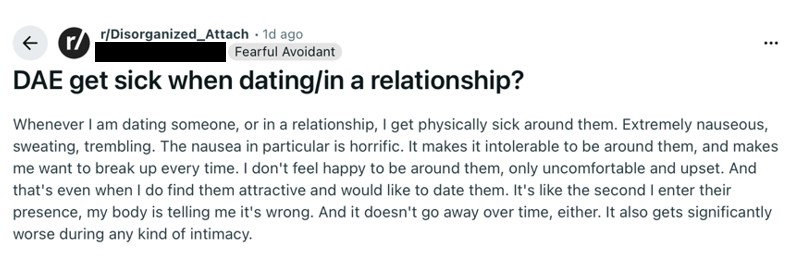
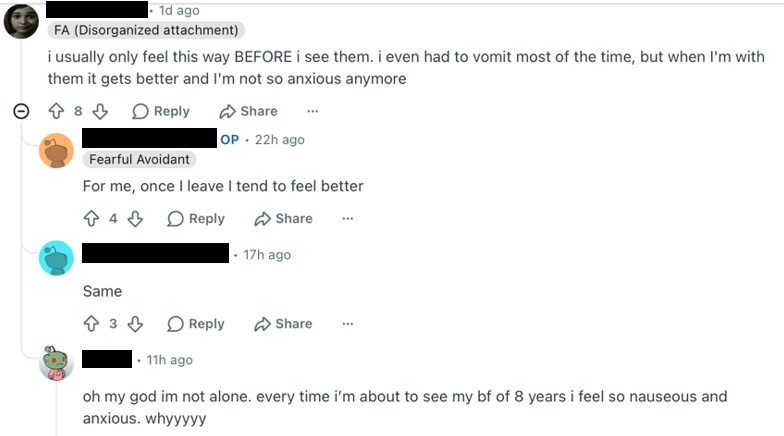
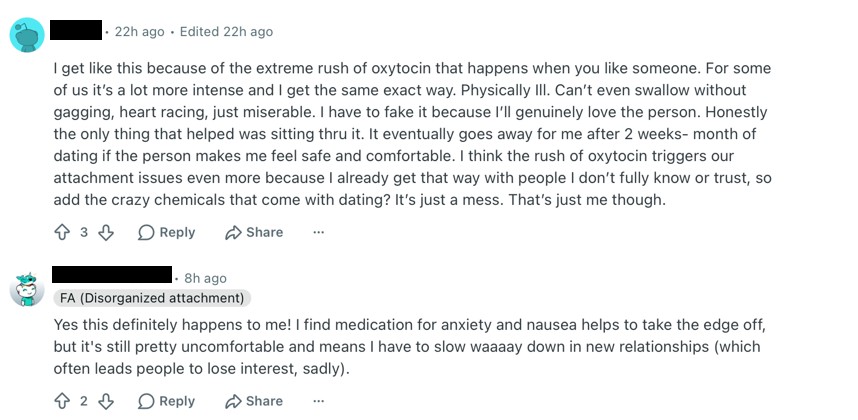
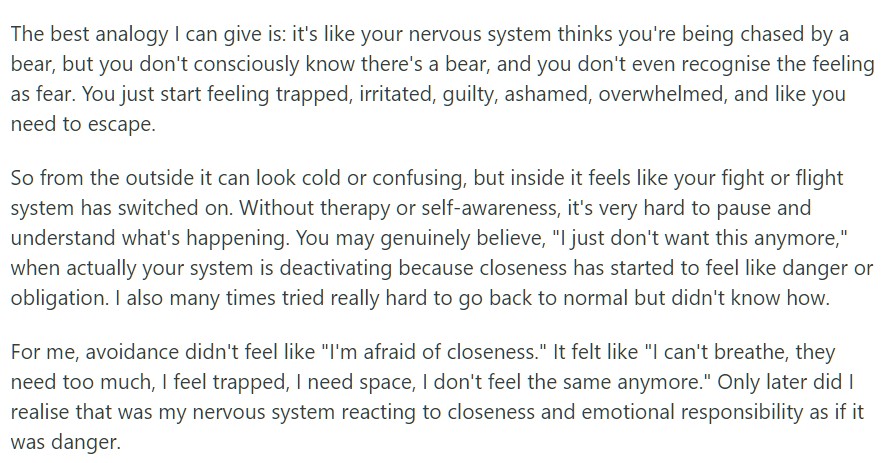
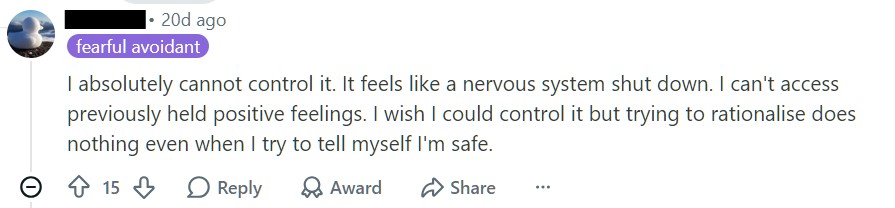
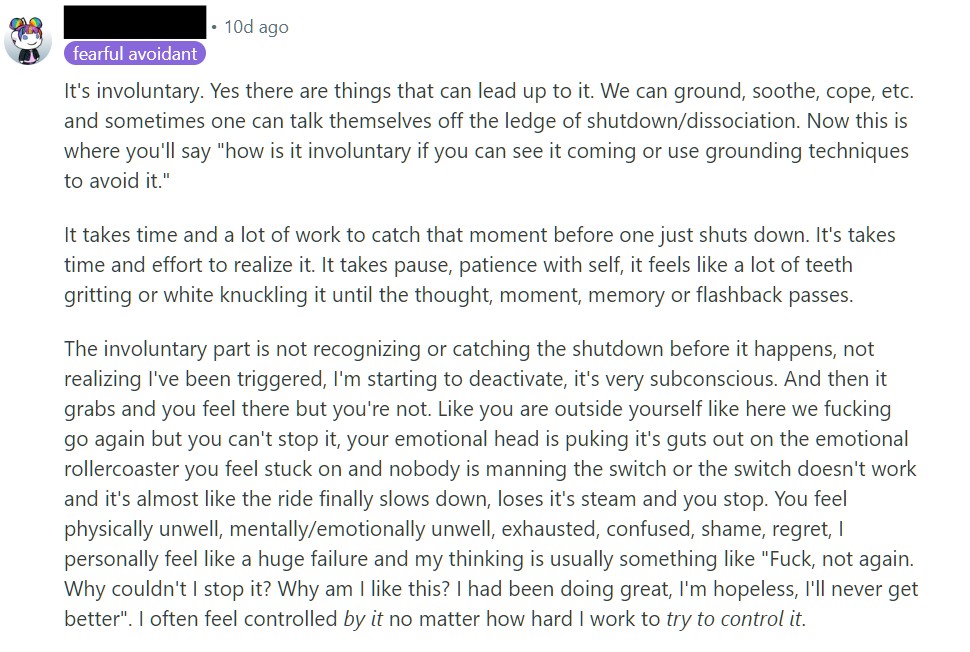
While every person is different, there seems to be some common themes listed by people with fearful-avoidant attachment on Reddit:
Feelings manifest in a very physical way; not just emotional

Many things trigger the anxious and avoidant sides of FAs


Deactivation seems to be a subconscious experience that is extremely difficult to control

Understanding is not the same as excusing
Reading first-hand accounts from people with fearful-avoidant attachment makes one thing very clear:
This can be an incredibly difficult attachment pattern to live with.
Many self-aware FAs describe intense physical anxiety, shutdown, emotional numbness, confusion, shame, and a feeling that their own reactions are happening faster than they can consciously control them.
That deserves compassion. But compassion and accountability can exist at the same time. Understanding why someone withdraws, deactivates, lashes out, disappears, or sends mixed signals does not mean you have to accept behaviour that repeatedly hurts you. Attachment style may explain behaviour - it doesn't excuse it.
But you cannot regulate another adult’s attachment system for them or force self-awareness on them. You can't love someone into recognising a pattern they are not willing to look at, and you definitely can't heal someone by repeatedly abandoning your own needs. For meaningful change to happen, the fearful-avoidant person has to become willing to recognise their triggers, take responsibility for how they respond to them, and learn new ways of handling closeness, conflict, and fear.
You can understand their wounds without volunteering to become the bandage.
Can FAs Become More Secure?
Yes ... fearful-avoidant attachment is not a life sentence.
Attachment patterns can change over time, and people with fearful-avoidant tendencies can become significantly more secure. In attachment research, this is sometimes described as developing earned security - learning healthier ways of relating even if secure attachment was not your starting point.
But healing fearful avoidance usually takes more than simply recognising the label.
Knowing:
“Oh. I’m fearful avoidant.”
is useful.
Actually changing the pattern when your entire nervous system is screaming:
“RUN!”
or:
“DON’T LET THEM LEAVE!”
is another matter entirely.
People who describe themselves as healing from fearful avoidance often talk about the amount of consistency, self-awareness, practice, and emotional work involved.
Healing may include:
- Recognising triggers before reacting to them;
- Learning to identify emotions instead of immediately acting on them;
- Tolerating vulnerability without automatically pulling away;
- Tolerating distance without assuming abandonment;
- Communicating needs directly;
- Staying present during conflict;
- Learning to regulate intense emotional reactions;
- Questioning old assumptions about intimacy and trust;
- Developing healthier boundaries;
- Working through earlier relational trauma or attachment wounds.
For many people, therapy can be enormously helpful, particularly if their attachment pattern is linked to trauma, chronic emotional dysregulation, or deeply ingrained beliefs about relationships. Unfortunately, there is no magical three-step attachment hack.
Healing tends to be repetitive.
You notice the trigger → You react slightly less automatically→ You repair faster → You recognise the pattern sooner next time → You make a different choice.
Then you do it again ... and again ... and again.
Why Fearful Avoidance Can Be Particularly Difficult to Heal
Fearful avoidance can be especially complicated because the person is often trying to regulate two opposite fears. The strategy that calms one side can activate the other.
Closeness may soothe abandonment anxiety but trigger vulnerability. Distance may soothe the fear of intimacy but eventually trigger fear of loss.
So healing is not simply about becoming “less avoidant” or “less anxious.” It often means learning how to tolerate both closeness and independence without treating either one as a threat.
Self-Awareness Has to Come From Them
This is perhaps the most important but frustrating part.
You cannot force somebody into self-awareness. and you cannot do their healing for them. Real change usually begins when the fearful-avoidant person recognises:
“This pattern is hurting me and the people I care about.”
and then decides:
“I want to do something differently.”
Without that willingness, attachment knowledge can simply become another explanation for the same behaviour. Self-awareness without accountability does not create security.
What Healing Actually Looks Like
Healing doesn't mean never becoming triggered again. A much better sign of progress is that the pattern becomes less automatic.
Before healing: trigger → panic → withdraw/pursue → damage → regret
During healing: trigger → react → recognise → repair
More secure: trigger → recognise → regulate → communicate
The alarm may still go off.
The difference is that they stop treating every alarm like proof the building is on fire.
Fearful avoidance can change - but it usually changes because the person becomes willing to understand their own patterns, practise different responses consistently, and take responsibility for the impact of their behaviour.
FAQs
Final Thoughts on Fearful-Avoidant Attachment
Fearful-avoidant attachment can be difficult to understand because so much of it appears contradictory. Someone can genuinely want love and still become frightened by intimacy. They can miss someone while avoiding them, seek reassurance and then feel overwhelmed by it, or care deeply about a relationship while struggling to behave consistently inside it.
Understanding those contradictions can make the behaviour feel a little less mysterious, but attachment theory is a map, not an excuse.
Knowing why someone struggles with closeness, trust, vulnerability, or conflict does not mean you have to tolerate behaviour that repeatedly hurts you. And if you recognise yourself in these pages, an attachment pattern isn't a verdict on who you are or how your relationships will always be.
Attachment can change. The goal isn't to reach a point where you never feel triggered, frightened, or tempted to fall back into old protective strategies. It's to recognise those reactions sooner, understand what is happening underneath them, and gradually learn to choose a different response.
Attachment may help explain where the pattern came from. It doesn't have to decide where you go next.
Other articles you may find interesting:

Avoidant Discard
Why avoidant partners suddenly pull away, and how to find your way back to yourself.

Dismissive Avoidant Attachment
Understanding the signs, triggers, deactivation, & how it affects relationships

Signs An Avoidant Is Done With You
How to tell the difference between deactivations, shutdowns, and discards.